Destination Overview
Where tours can take you
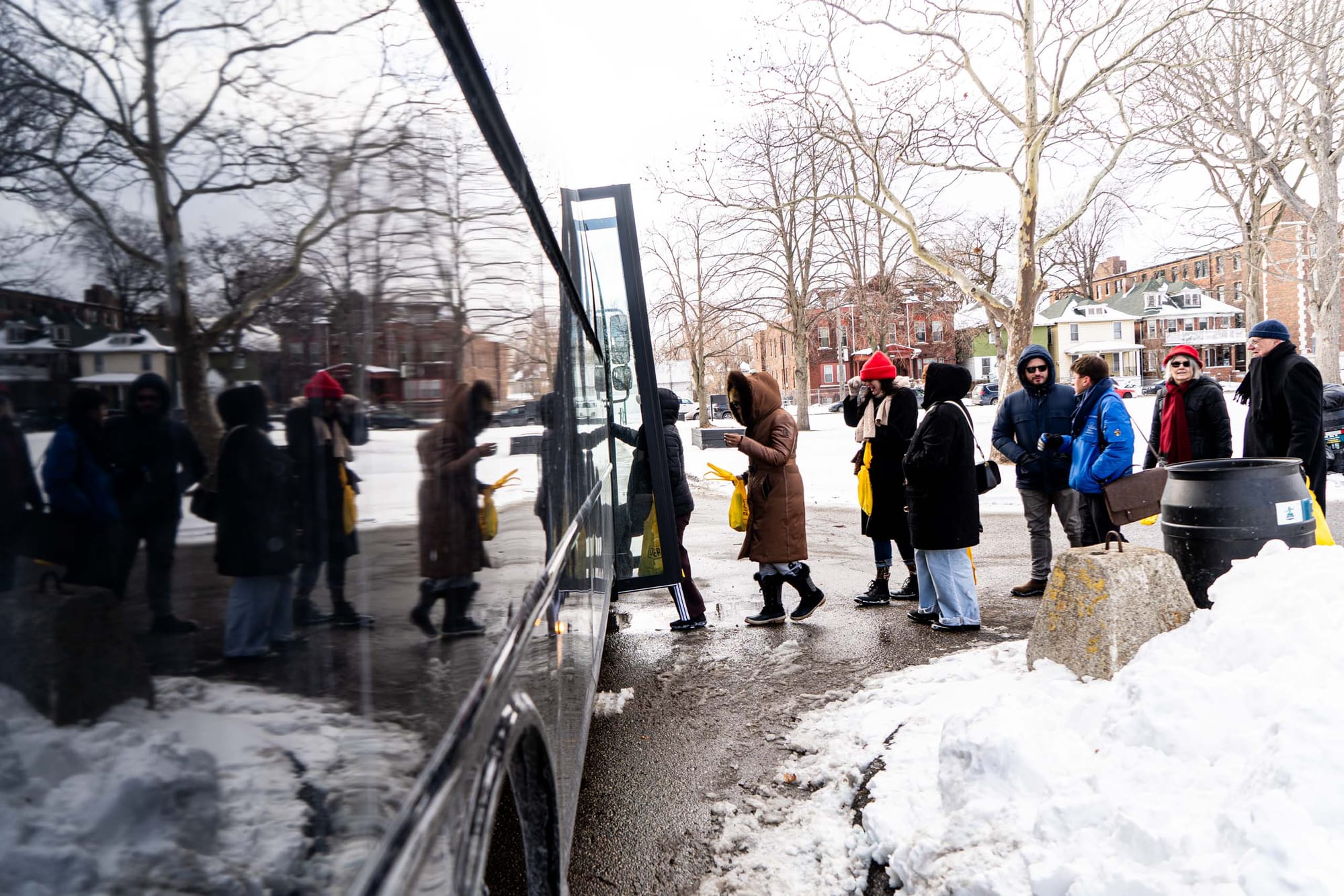
Journalists are already guides. Through written word, audio, and video we take people to places and explain what’s happening in their communities. Walking tours offer another medium for local journalism.
Top Attractions: Why offer tours
Connect with new and existing audiences
- Existing audience members attend tours deepen their relationship and understanding of coverage.
- Tours offer an introduction for potential audience members who can sign up to learn more.
- Both groups get to ask questions, shape the tour content, and connect with one another.
Diversify and generate revenue
- Paid tours cover costs and generate revenue for each attendee.
- Offer tours as a membership or subscription benefit for an audience revenue program.
- Offer free or low cost tours underwritten by grants or sponsorship.
Share news and information
- Share local news and information through a curated itinerary and script.
- Demonstrate local knowledge, expertise, and showcase original reporting.
- Listen and collect attendee input on what topics resonate, or don’t. Directly respond to questions in real time.
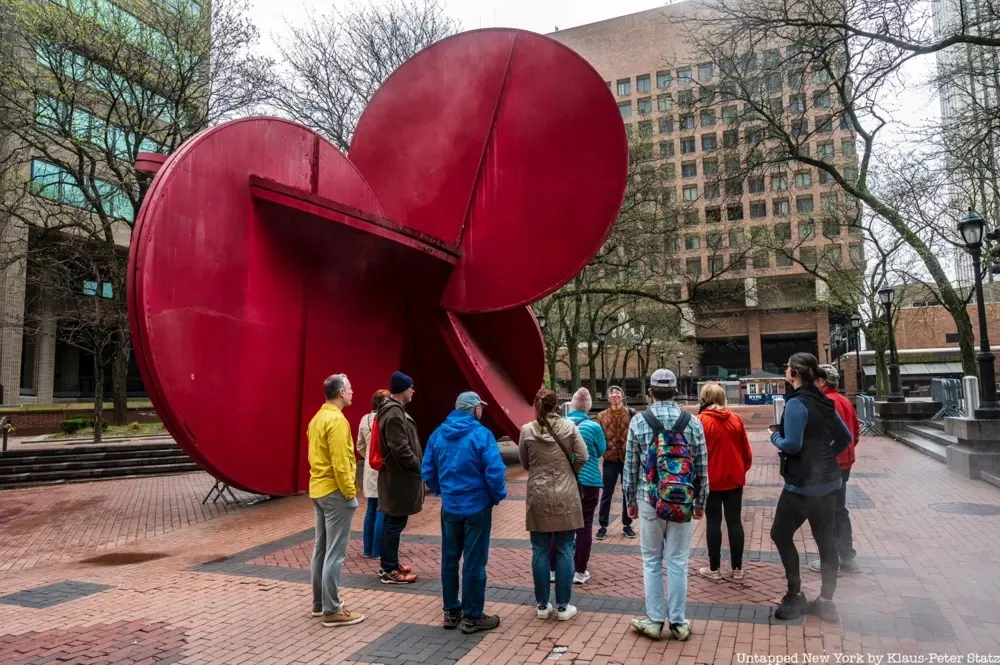
Benefits of the tour model
medium/ˈmē-dē-əm/noun: a means of effecting or conveying something
journalism/ˈjər-nə-ˌli-zəm/noun: the collection and editing of news for presentation through the media
tour/ˈtu̇r/noun: a journey for business, pleasure, or education often involving a series of stops and ending at the starting point
Tours as a medium for journalism = A journey for business, pleasure or education involving a series of stops as a means of conveying the collection of news.
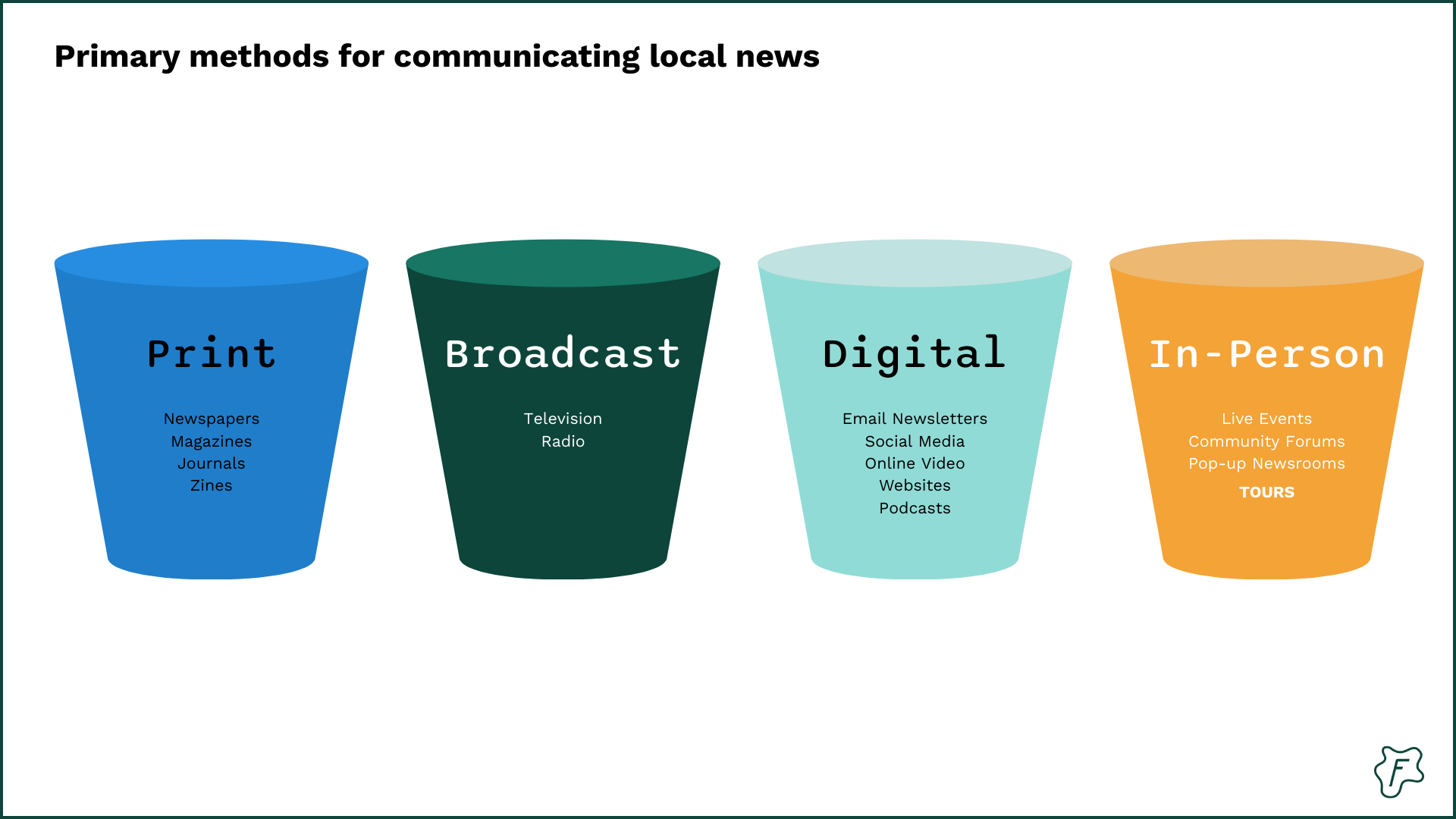
There’s an increasing number of mediums used to convey news and information, however, most fit in one of these buckets:
- Broadcast
- Digital
- In-Person
Tours fit into the in-person bucket, which is typically used in tandem with one of the other three mediums.
Events vs. Tours
“The disadvantage of the event is you’re not in the field…if I do a building stone tour, I can’t get that tangible aspect of someone reaching out and touching it.” — David B. Williams, author
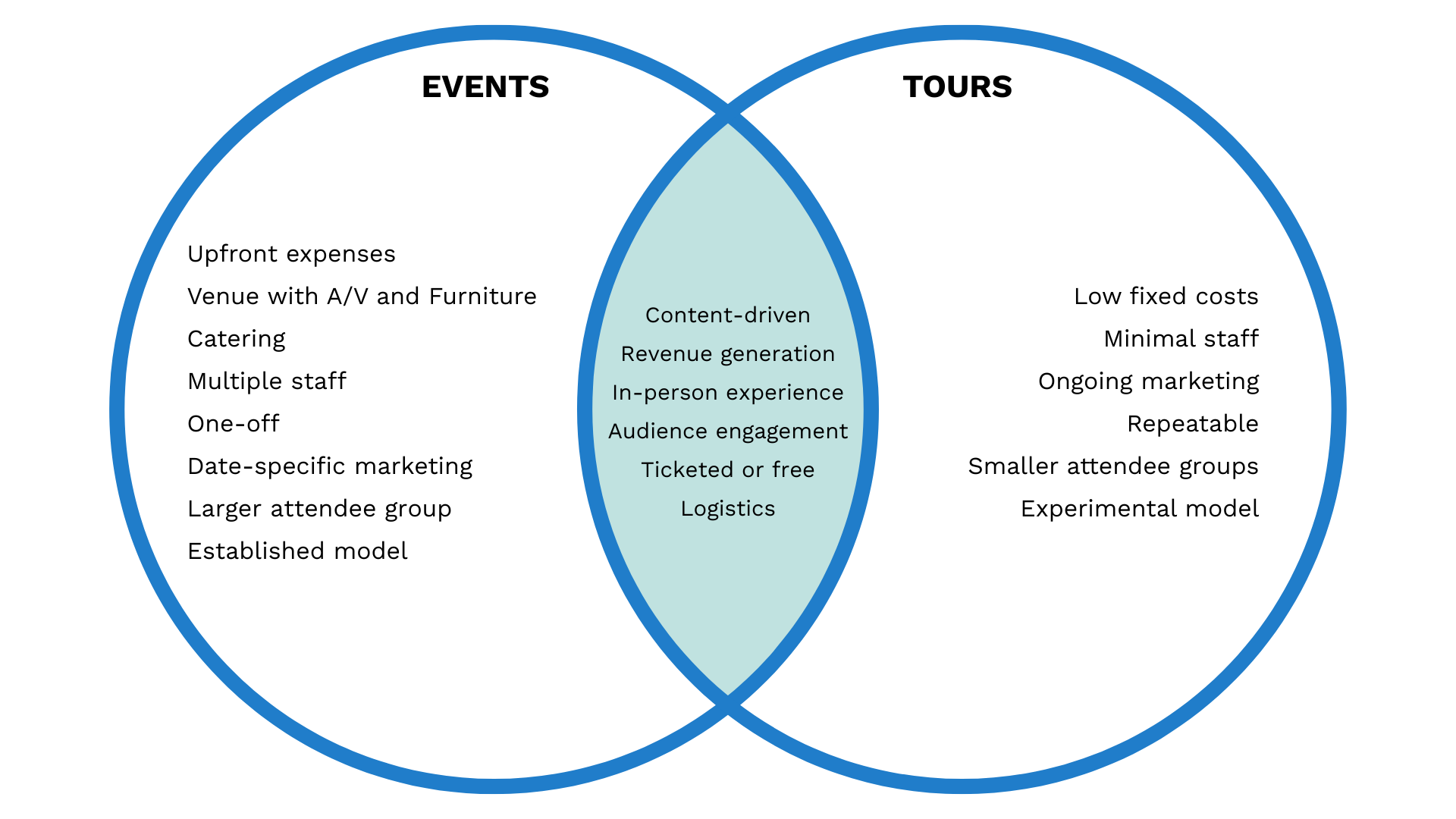
Publishers big and small have adopted live events as part of what The Lenfest Institute calls “the post-print revenue mix.” Despite setbacks from the COVID-19 pandemic and inflation, events remain a key in-person experience, but they aren’t the only option.
Even at its most basic, an event requires a venue with equipment, staffing and date-specific marketing. There are upfront costs and it may or may not be profitable. Tours offer an alternative.
“It's a very low fixed costs operation to do tours, because in many cases it's just people walking around. So it's very easy and flexible to put together,” said Augustin Pasquet, CEO of Untapped New York. “It’s also low coordination.”
Once you have a time and a place — that’s it — you can repeat the tour. This repetition is key.
While you may have 10-20 people on a tour, compared to a 200-person event, you can repeat the same tour again and again. Over time, that adds up.
“Whereas an event, it's a one off thing, and then when it's done, it's done,” Pasquet said.
However, events do offer potential benefits like larger reach, a higher ticket price, and a more established model in journalism. David B. Williams, an independent author who gives tours, said events allow for more attendees and in a contained environment versus helping a group navigate the streets.
A service: Sharing news and information
Tours allow journalists to…
- Share local news and information through a curated itinerary and script.
- Demonstrate local knowledge, expertise, and showcase original reporting.
- Listen and collect attendee input on what topics resonate, or don’t. Directly respond to questions in real time.
Editorial content
The content of a tour — the information shared, storytelling style, visual aids, questions for and from attendees — is the result of an editorial process.
For over a decade, journalist and educator Jeff Jarvis has argued that journalism should be considered a service, not a product or content business. There’s much more to this argument but for this guide, it is important to step back and separate the act of reporting the news from the article format.
Creating a tour itinerary is like defining coverage areas or beats. Newsgathering, research, and voice inform the tour’s script. Accuracy, attribution, and regular updates uphold high journalistic standards.
Don’t overlook background or evergreen information. Part of being a journalist is to be informed and in the know. Over time, it’s easy to lose sight of what information might be new or bear repeating for local residents.
Like a compelling news article, strong tour content is memorable and impactful, leaving attendees better informed to engage with their community.
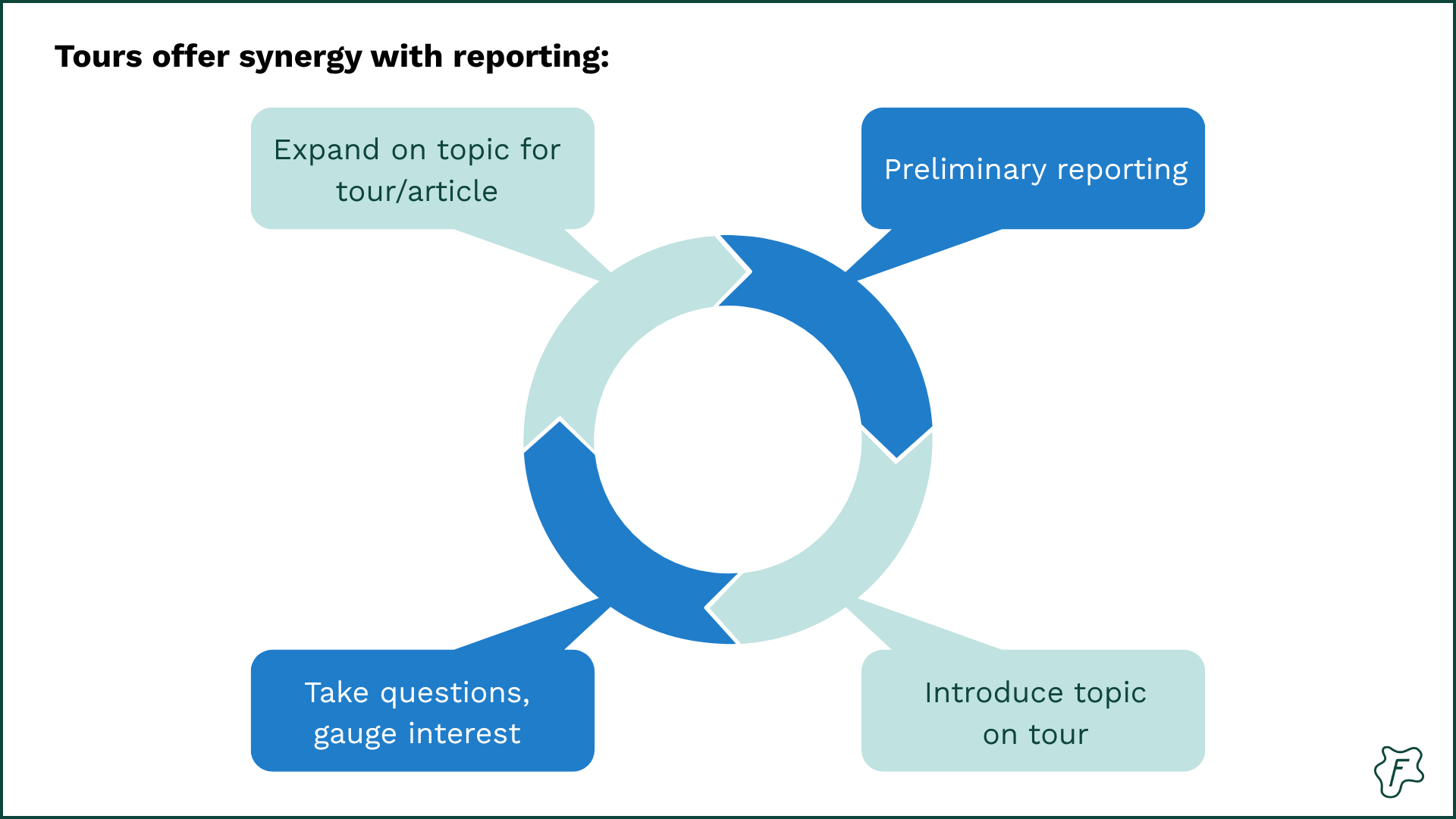
Synergy with reporting
Consider the typical path of an online news article: Find a lead, pitch the story, write, edit, and publish, sending a (pretty much) final version out into the world uncertain of its reception.
A number of newsrooms are breaking away from this cycle by engaging audiences earlier in the process and prioritizing community-driven journalism. This can be resource intensive and the end product is still primarily written articles.
The opportunity for community input is an added benefit of tours. It’s also an avenue to provide brief updates, without producing additional news articles.
It’s incredibly difficult to decide what to cover, or how often to cover certain issues. Some will only come up on tours. Others will become articles, podcasts, social media posts or email newsletters, and benefit from the audience questions and comments received during the tours.
Listening
Listening is a core principle of community-centered journalism. That is, journalism that reports with community members, not just about a community. In many ways, this is a course correction from the top-down approach of conventional journalism.
Since Andrea Wenzel’s 2020 book on the topic, a growing group of local publishers are applying the principles of community-centered journalism in order to:
- Build (or rebuild) trust in news media as it continues to decline.
- Produce reporting that is relevant to real community concerns, at a time many people avoid the news.
- Connect with new, diverse audiences underserved by traditional media.
- Deepen understanding and strengthen community ties.
The future of news and the promise of community-centered journalism via IJNET
Listening to reach new, diverse audiences via Trusting News
Civic Media Playbook via Listening Post Collective
Listening is also a key part of product development, understanding user needs and making sure your product or service actually meets those needs. If your goal is to be relevant and grow a highly engaged audience, then prioritizing listening is a practical choice.
Sometimes, people are terrible at listening. Sincere listening takes practice and that’s where tours fit in.
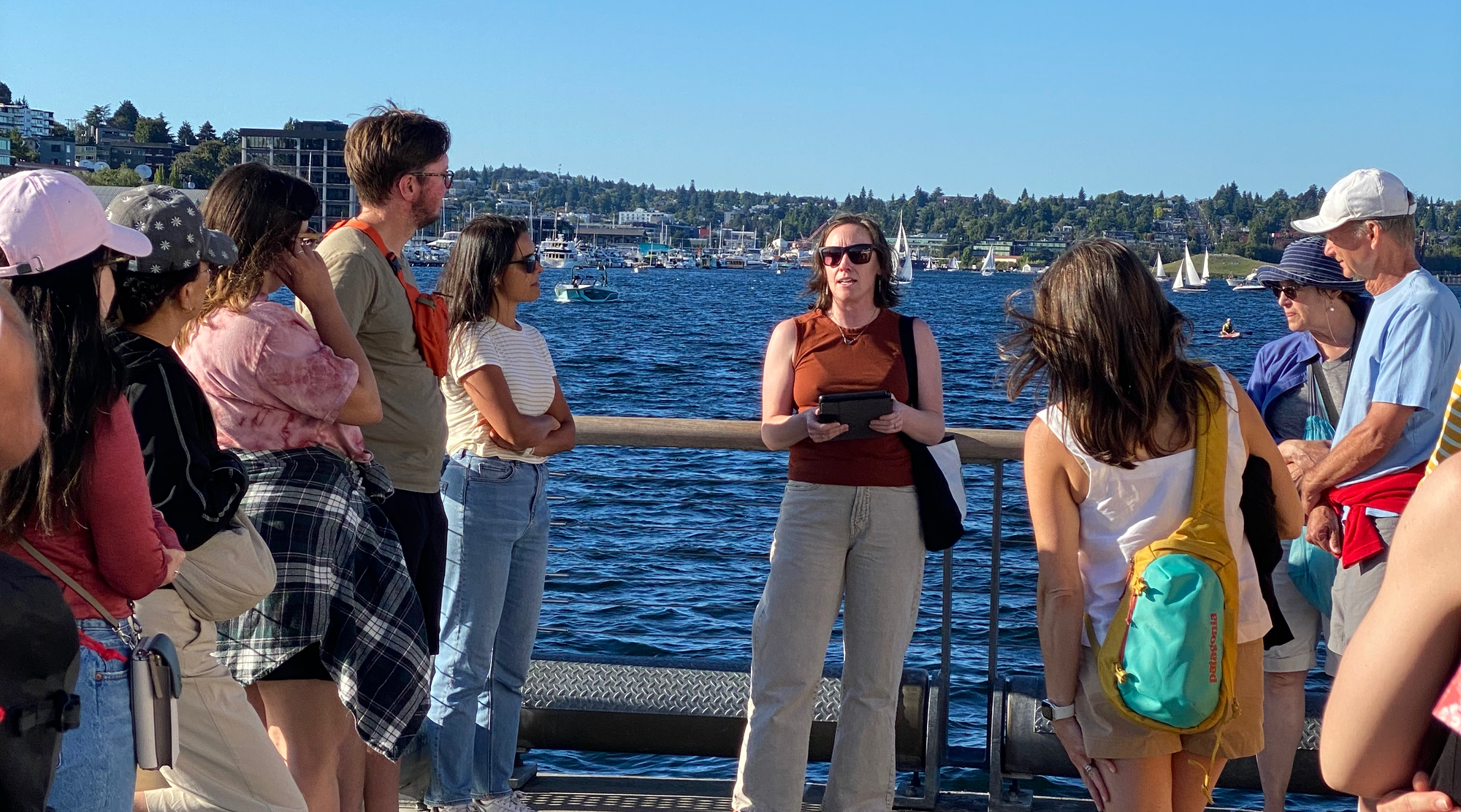
Tours present an opportunity to be transparent, listen directly to attendees, and respond to questions. Unlike a time limited listening project — another powerful community-focused approach — it also helps make listening routine.
Attendee questions and input can help you understand what topics resonate, and what doesn’t. This in turn can help newsrooms prioritize or test new approaches to dense issues. Each tour is a small focus group, a new opportunity to test and listen.
Diversify and generate revenue
Relying on one source of revenue is risky. Emerging and existing news organizations are continually encouraged to diversify their revenue streams.
Adding tours, which are relatively low cost to operate, fits into this strategy and there are several potential revenue models.
Free tours
Offering tours at no cost is ideal for a pilot program, and maybe even long term. That doesn’t preclude generating revenue, though. Here are three approaches:
- Ask attendees for a tip, donation or contribution at the end of the tour. This “give what you want” approach also provides an indication as to how much people value the tour.
- Apply for grant funding to keep tours free and accessible. Potential funders may be outside of journalism, consider community foundations or cultural agencies.
- Sell a presenting sponsorship to a business or organization that wants to be associated with your tours. This could be either exclusively for the tours or packaged with other recognition.
If the arrangement allows, grant funding and sponsorship could also be used in combination with paid tours, either to grow revenue or to offer lower priced tours.
Paid tours
As Untapped New York demonstrates, charging $40-100 per person for over two dozen different guided two-hour tours adds up. They also offer private and customized tours at higher rates.
This model is most similar to the tourism industry, and it's important to be clear about:
- The cost of operating tours
- Prices of tours and other experiences in the local market
- A system for collecting payment and providing customer service
Since walking tours can be operated with minimal expenses, the profit margins may be much higher than other revenue streams.
Member-only tours
Use limited access to boost an audience revenue stream, like memberships or subscriptions. It could increase sign ups, if someone is incentivized by attending a tour, or improve engagement and retention of existing members or subscribers.
This could also be used alongside free or paid public tours, with select tours offered as a member or subscriber benefit.
Tips or donations
At tourist destinations around the world, tipping at the end of both paid and free tours is not uncommon and sometimes even part of the business model. For example, Berlin is famous for free walking tours with tips as the guide’s income.
You won’t receive contributions unless the guide asks. There are a few ways to frame this:
- Value - Focus on the specific tour experience. If they enjoyed it or had a good time and wish to tip, it’s appreciated.
- Support - Help us continue tours and experiences like this and keep them free or low cost by supporting our (for profit) organization with a contribution.
- Donate - Talk about the mission and other work you do. Ask for a donation to support a nonprofit or fiscally sponsored organization.
Use digital payment tools such as Venmo, Stripe and Square with a QR code to create a virtual “tip jar.” Asking for contributions this way can also help you understand what attendees feel the tour is worth, which could factor into pricing of paid tours.
Sponsorship
Build a sponsorship package either exclusively around tours or bundle the tours with other events or digital advertising, especially if you have an existing sponsorship program.
Benefits for sponsors could include:
- Recognition on the tour website, in emails to attendees, and on social media
- Acknowledgement during the tour and an introduction to the sponsor
- Handing out marketing materials to tour attendees
- Providing a question for the post-tour survey
- The tour starting or ending at their building
Potential sponsors include local businesses, economic development or civic organizations, cultural institutions, or property owners.
Consider their motivations, whether that’s connecting with a group of engaged local residents, raising awareness about a particular cause or place, or looking to drum up business during a slow time of year.
Grants
The grant landscape is complex and varied. For grants focused on specific beats or projects, a tour initiative might be a good fit.
Design a tour to meet your organization’s needs first, not in response to a grant application. Once you’ve got a plan, then look for open calls or potential funders that align. Since staff time is a significant portion of a tour budget, make sure the grant will help cover that.
Visit Grants for Journalists from RJI Fellow Monica Williams to find money for reporting and journalism projects. Also explore non-journalism funders who may be active in your community or focus area.
Connect with new and existing audiences
Perhaps the most important part of a tour? The people who come. It’s about them.
Tours can attract existing audience members, new-to-you community members, or a combination of both. The format, structure and marketing shape the attendee list.
Think about how tours might fit into one or more audience funnels:
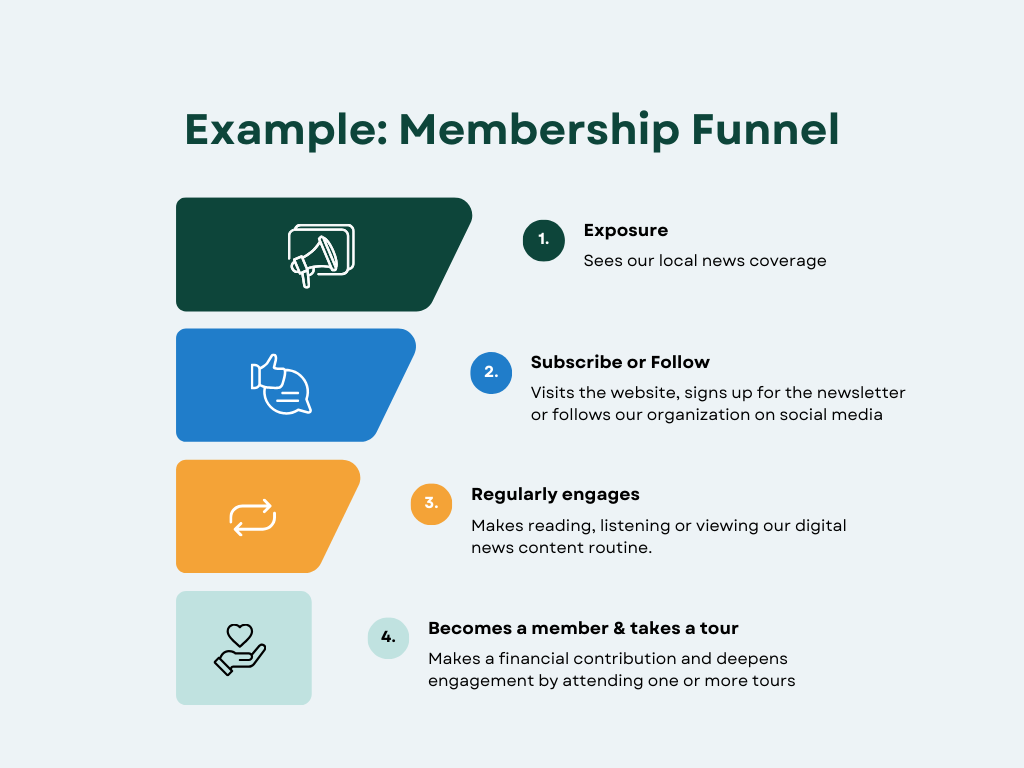
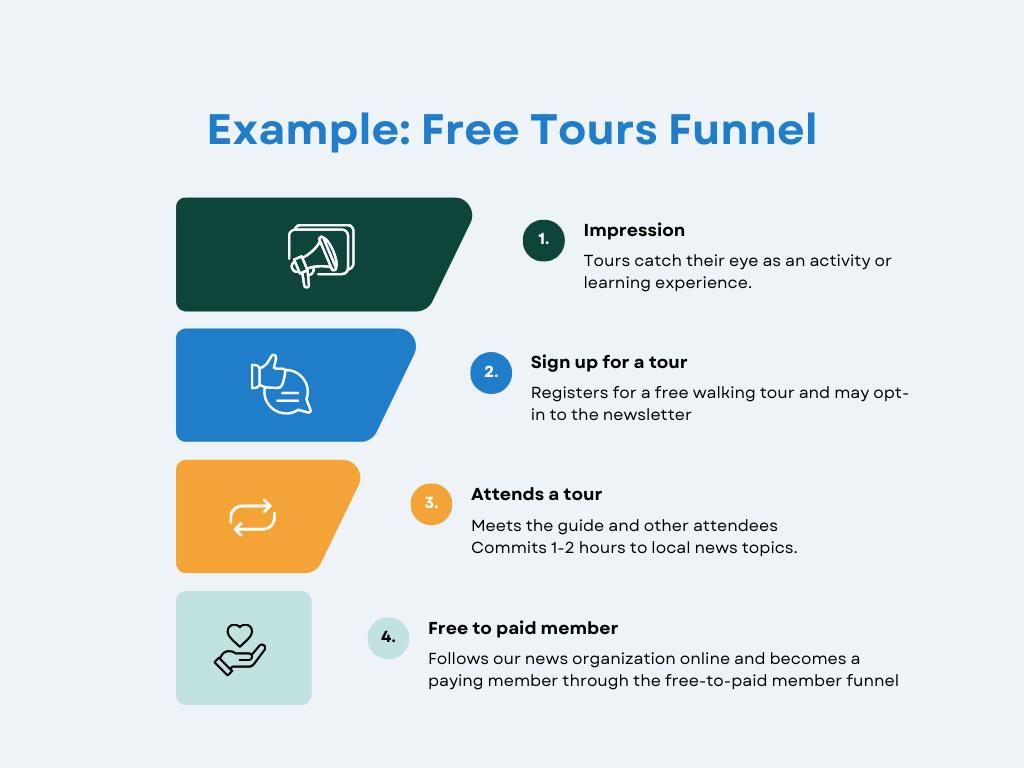
Create your audience funnel from LION Publishers
Audience funnel: A primer from Better News
The experience of the people on the tour, whether called attendees or guests, is paramount. They are giving you two to three hours of their time and attention when the average engaged time on a web article is seconds.
This is the moment to demonstrate the value of local journalism and deepen your relationship with them. It’s also a time to help attendees connect with one another and the place you’re touring.
Operational sustainability
Burnout is a major issue in small and local news organizations. Spinning up an entire tour business in a matter of months while still operating a publication is unrealistic for most.
Making money and growing audiences are major issues, though, so media leaders need to take action and that’s what the rest of this guide focuses on.
As described above, tours are repeatable with low fixed costs compared to events. The content ties into existing coverage. A well-executed tour brings revenue, audience and journalism together in one place.
A tour pilot allows testing, without a major investment. It strips tours down to the “must haves” with a finite timeline. Newsrooms should think big when it comes to tours, but start small and leverage product thinking.
To get some big ideas, let’s learn more about the largest tour operator featured in this guide: Untapped New York.
Case study: Untapped New York
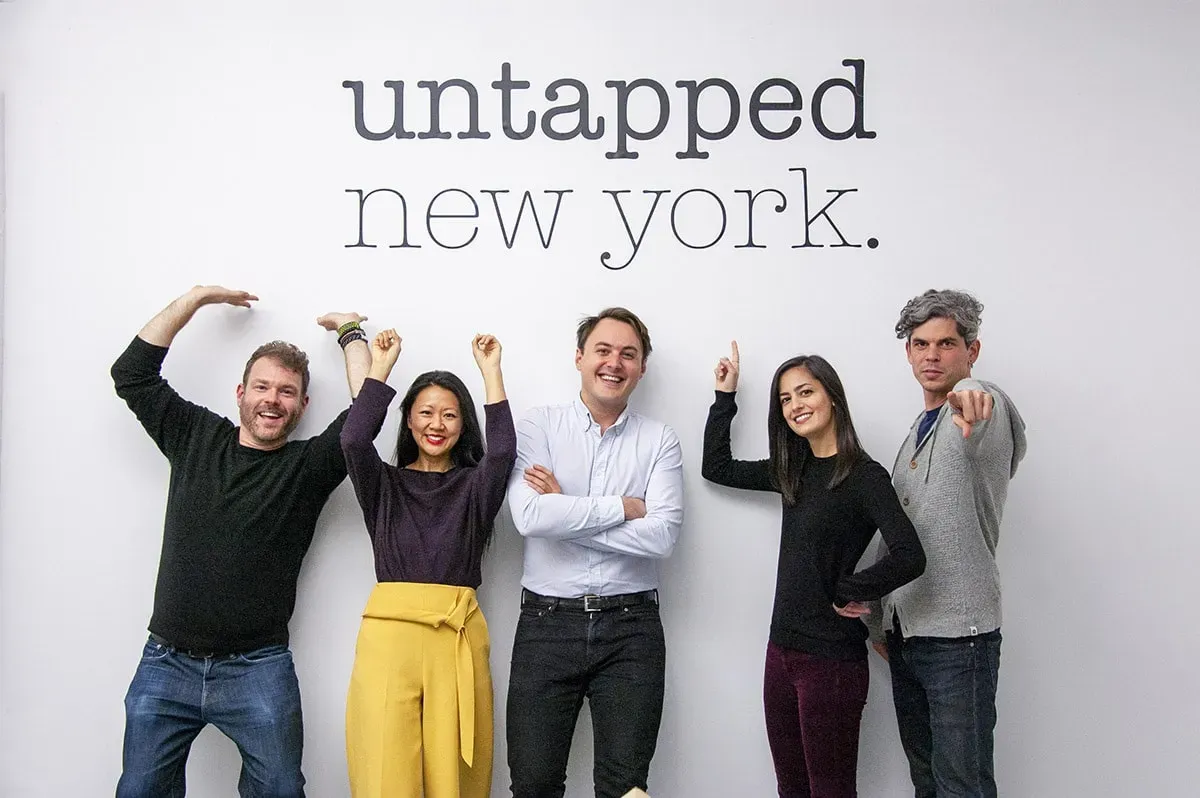
Michelle Young founded Untapped New York, an online magazine to help New Yorkers rediscover their city, in 2009. Augustin Pasquet, her husband, later joined the business and is now CEO. The “experience” department is led by Justin Rivers, who develops new tours and manages guides.
Untapped currently offers over two dozen tours catering to locals, tourists and their members. They hosted approximately 20,000 guests in 2025. With over a decade of tour operation experience, and a business model that’s shifted to adapt to changes in digital publishing, they shared valuable insights and practical tips about tours.
The backstory
“We fell into the tour business by accident” — Augustin Pasquet, CEO of Untapped New York
Untapped New York’s first tour in 2012 was a “two-in-one situation.” It raised awareness about the tour location, the historic Woolworth Building, and allowed Young to meet her audience, which at its core are local New Yorkers.
"Google Analytics is great, but it's also not like interacting with someone and asking them, 'Hey, why do you read our website and what do you like about it?'" Pasquet said.
This “different type of data gathering” allows you to a) meet your audience and b) raise awareness for the place that you tour.
Pasquet said this still encapsulates what is great about doing tours as a publication.
That first tour set off a light bulb for Pasquet, who has a background in marketing and business. He spotted a new revenue opportunity with upfront payment and low overhead costs. It also resonated with Untapped New York’s mission of discovery.
From side project to growing business
A couple years after the first tour, Pasquet was looking to leave his job at L’Oreal and brought his outside perspective to Young’s business.
“You're not in the business of publishing articles. You're in the business of discovery,” he recalled telling Young.
After that, tours shifted from a fun, creative side-project to a pillar of the publication’s business.
While advertising is also a source of revenue, Pasquet said tours are better for cash flow, since you collect money before the tour and pay tour guides afterwards. With ad revenue, it’s the opposite.
“You provide a service today, which is, you rent space on your website, and then you're paid like 30 to 60 days later,” Pasquet said.
Pasquet is a big fan of the recurring business model that comes with tours. They can build promotion around it and respond to demand. If demand is strong, they keep sales open, adding times or tour guides to maximize that opportunity. He prefers this “demand-first” approach over an “offer-first” approach.
“Milk it while you have it,” he said.
This flexibility extends to what tours are available. Even if Untapped New York stops offering a specific tour, if someone asks, they can bring it back.
“The cost of carrying a tour is low because it's not like you have to carry inventory or anything,” Pasquet said.
He called it “easy-ish” to bring back a tour, or create a new one, as long as there’s enough knowledge among the guides. When developing new tours, they invite guests for free and gather feedback like a focus group.
Their tour business also overlaps with their sponsored content arm. If there’s a place they are interested in accessing, they can trade a sponsored article for access and then generate revenue from an exclusive tour.
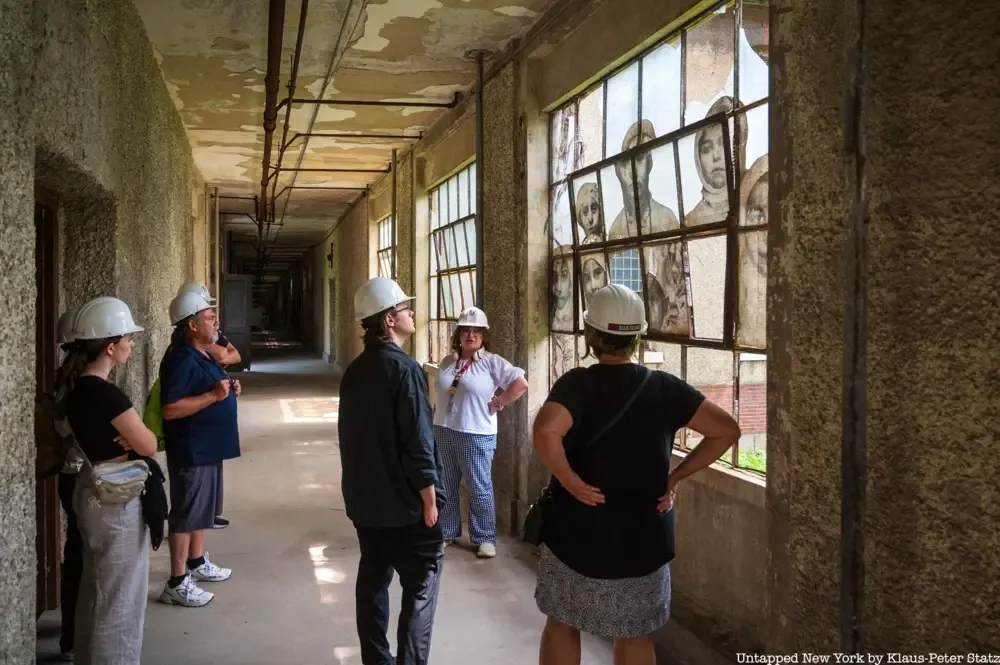
Partnerships are key, including with nonprofits like Save Ellis Island. The longstanding partnership allows Untapped to offer tours of an abandoned hospital on Ellis Island.
The power of place and quality
“You have 30 people who engaged with the space, and that is so much more powerful than those same 30 people reading an article,” Pasquet said.
He added that some of these engaged tour guests become members or recurring customers, and even donate to their nonprofit partners.
Untapped also operates in a place unlike any other: New York City.
While they can, and have, tapped into New York’s massive tourism industry, Untapped’s core audience is made of local New Yorkers. This continues to inform their tours, setting a high bar for the content and creating a competitive advantage in the tour market.
“Anytime we launch a tour, we always put it to the test of… ‘if I've lived in New York my whole life, will this tour surprise me?’ And if so, then it will surprise also someone who just landed and who doesn't know anything about New York, but it first has to pass that high bar test of surprising a local New Yorker,” he explained.
Pasquet emphasized the importance of quality, comparing Untapped’s tour business to a restaurant. Both repeat the same things over and over, but it’s always new.
“You provide service or product, and you're as good as the last plate you sent in your restaurant. For us, we're as good as the last tour that we did.”
Practical advice
For anyone adding tours, Pasquet’s main advice is to have all the right systems in place from the get go. To build this foundation, he recommends:
- Starting with software that meets your needs today and if you grow 100 times. Use a tours software, not something for events.
- Get tour-specific insurance and manage your risk. Partners or property owners may request an insurance certificate or ask to be named as additional insured.
- Know the regulations. While a “pretty low regulation business overall” learn if your city requires permits, licensed guides, or limits group sizes in public spaces.
Other simple, yet essential additions to consider:
- Use amplification or a wireless tour guide system to ensure all attendees can hear.
- Instructions about the meeting and ending location can never be clear enough.
- Create a connection with your guests — it can be anything from remembering their names or where they’re from. Ask questions at the very beginning and incorporate what you learn back in the tour.

A tour company or a publication?
For many years, Untapped only promoted tours to their readers. Now, they’re promoting beyond their audience through ads and by reselling tours on Get Your Guide, Viator, and Airbnb. Untapped also resells other tours, like boat tours on the Hudson River, and earns a commission.
“We could argue that we're a tour company, but when you get on our website, we're first like an online magazine, and now we have a lot of guests every day on our tours,” Pasquet said.
Financially speaking, Untapped now makes more money on tours than advertising or membership. Tours are proving to be a powerful approach towards their “business of discovery.”
“The job of the tourism industry is to bring people who want to see and do stuff. And when you do tours, you show, you see and do stuff. So like, basically, there's just a natural match,” he said.
Pasquet is following that demand as Untapped New York navigates the ongoing media and technology shifts in its second decade.